CRITICAL COMMENTS
Dorothy Hall, NY Park East, March 23rd, 1974, NYC:
“Galerie Internationale is featuring a one-man show of paintings by Italian artist Giuseppe Dossena. These are exuberant works in rich, assertive color, dealing with varied subject matter, both abstract and representational. In either case, there’s a feeling of nervous energy bursting forth in the artist’s treatment of generously flowered fields, butterflies, still lives, and dancing figures such as in Giorno di Festa as well as in the breathless swirls which conjure up a vision of ghosts in Fantasmi.
Most appealing are several large landscapes in a somewhat more subdued and impressionistic vein and with a fresh, ingratiating palette. Pomeriggio Estivo (Summer Afternoon), with a hint of Van Gogh in the rhythmic sky treatment, is particularly lovely as is Bambini nel Giardino, a sunny springtime view of children playing in the park”.
Mario Albertazzi, Il Progresso Italo-Americano, New York, May 18th 1969:
“Dossena’s opus is stimulated by a strong need to communicate… In his most recent works, the artist shows off a wide range of colors and tones that express the shape, while leaving the viewer broad interpretative possibilities…”
Mario Albertazzi, Il Progresso Italo-Americano, New York, March 26th 1974:
“Galerie Internationale has a current exhibition of the known painter, sculptor, and restorer, professor Emilio Giuseppe Dossena. The artist is known for the musicality and brilliance of his colors and the idealization of his subjects… The exhibit is particularly successful and constitutes a spiritual and aesthetic delight for the visitors…”
Mario Albertazzi, Il Progresso Italo-Americano, New York, April 8th 1974:
“More than deserved the success reported by the painter Emilio Giuseppe Dossena in its recent personal show at the Galerie Internationale. Brilliant colorist, he brings in his paintings the light of nature and the joy of life. The sun kisses his flowers, his figures of women and children. The paintings of butterflies, games, laughter, happiness, are rich in blending and at the same time airy, vigorous, and delicate as a gentle caress. “
 Sandy Auriti, L’Idea N.72, Vol.II, December 1998, New York
“Friday, November 20, in the presence of Consul General
of Italy in New York and Connecticut, Giorgio Radicati, and a large audience, the retrospective of the artist Emilio Giuseppe Dossena was held in the prestigious halls of the Trask Gallery at the National Arts Club, located at 15 Gramercy Park South, in Manhattan.
The exhibition… wants to be a journey of the personal and artistic life of the painter, and was placed in the gallery in chronological order. Starting from the forties and using impressionistic techniques, the painter makes masterful use of the colors of his land, and with great sensitivity he perceives the world, testing it as an artist and individual, from the use of colors: brown, ocher, yellow, sienna, burnt red, to the themes, ranging from nature to objects and characters. Dossena, in the paintings of this period, is the artist who observes and impresses on the canvas, once again, his personal reactions. At the same time, he also reflects the wide experience of international standing…
Dossena discovers himself as a poet on the canvas and in the fifties, this realization becomes more evident by acquiring a different point of view in reiterating the themes that interest him. There is more movement in the paintings, the characters are more important, the color changes, the red and the blue step in. Society is changing and the artist adapts to the new demands of the art world without forgetting the subjectivity that makes his work unique. He arrives in America [in 1968]… The U.S. experience has a great influence on the painter. It is during this time that the color takes on [an even] greater significance, while the style is slowly changing and getting closer to neo-expressionism.
At 72, Dossena, forced by the precarious health to remain at home, once again finds the strength and spirit to seek new forms of expression. The colors on the canvas of this period are strong; the brushstrokes carve on the canvas intense color harmonies that suggest to the observer the balance of form and content achieved by the painter… This is the first time an Italian event has been accepted and offered in the beautiful home of the National Arts Club…”
Mario Portalupi (Italian Art Critic):
In reality, his painting process is tied to the impressions and to the emotions that follow them, transforming reality and control the chromatic entities on the canvas…
The experience and the technique, along with the inspiration, confirm this artist as a good painter with a strong sense of communication.
Mariangela De Maria (ItalianArt Critic):
“Dossena’s painting is the lived ‘condition’ of his joy of life, the need to communicate in an archaic scenario the exuberance of color, to make his all every reality to adapt it to his imagination.
The figurative themes of Dossena’s pictorial realism are felt as a transposition of the romantic-emotional nature or as a mnemonic evocation of situations. They are landscapes, captured from the air as spreading planes, chromatic intersections, and tangencies repeated, multiplied, fixed in space and at the favored hour, they are rustic views or entertainment of figures in which the key vehicle is the color. A harmony of reds, greens, blues of independent nature, linger in the strict decorative framework of the paintings and they release him from an imitative criticism; the artist progresses, therefore, to treat the color as a function of his sensitivity.
When the chromatic evocations display lit harmonies in their contrasts, the transition from a transitive ‘composition’ to ‘expression’ is evident, so that the summary representation of objects in the demarcation of the design, is absorbed entirely by the need to arrange and compose by chromatic masses.
One can say that Dossena works within a conceptual antinomy of art’s expression, instinctively tied to the performance of some of the Fauves, of whom he feels the limit of the form, but in this collection, although he contradicts experience, he gives us an invitation to live his enthusiasm and his imagination. “
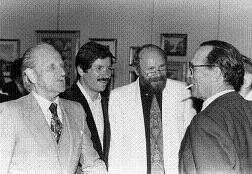 Mario Soldati [famous writer and movie director] made at the opening of the artist’s personal exhibition at the Circolo Meneghin e Cecca of Milan, Italy):
“We don’t have here only one painter, there are two of them: the one who painted the small paintings and the one who painted the large ones… To this artist, almost my age, I want to say one thing: please continue to create the small ones, or paint larger ones too, but always in the same style (of the small ones). I vastly admired these small size paintings, which I found full of inspiration… they make you dream because they are open to so many interpretations…”
 Emilio Giuseppe Dossena